
Automatic Accessibility Checker
How it Works
Digital Commons uses a third-party module to check your content for web accessibility. When you edit your website, the Editoria11y Accessibility Checker runs automatically to check for items that might be an accessibility issue.
A small control panel hovers over the bottom right corner of each page. If issues are found, the control panel displays a flag and the number of errors. You can select the panel for details about each issue. The panel explains why the issue is an accessibility error and tells you how to fix it.
Each error is also flagged on the page for you to easily find and correct. Indicator meanings are defined below with the corresponding control panel appearance.
| Editoria11y Key | Indicator | Meaning | Control Panel |
|---|---|---|---|
| Critical Error | 
| Items highlighted with a red exclamation mark (!) are confirmed accessibility errors and must be fixed. | 
|
| Potential Error | 
| Items highlighted with a yellow question mark (?) are potential accessibility errors that require evaluation to fix or dismiss. | 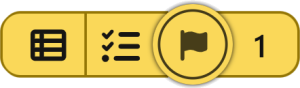
|
| No Errors or Errors Marked OK | 
| A blue check mark appears when no errors are found or potential errors have been "Marked as OK." | 
|
Issues Found
Editoria11y's automatic tests focus on issues it is confident need addressing. It explains the issues and how to correct them. Issues identified include:
- Headings
- Skipped heading levels
- Empty headings
- Very long headings
- Text alternatives
- Images without an alt element
- Images with an empty alt element (flagged for manual review)
- Images with a filename as alt text
- Images with very long alt text
- Alt text that contains redundant text like "image of" or "photo of"
- Images in links with alt text that appears to describe the image instead of the link destination
- Embedded visualizations that usually require a text alternative (e.g. Tableau, charts)
- Meaningful links
- Links with no text
- Links titled with a file name
- Links only titled with only generic text (e.g., "click here," "learn more," "download")
- Links that open in a new window without an external link icon
- Lists made with asterisks, numbers instead of letters rather than list elements (e.g., bullets, asterisks)
- Large quantities of CAPS LOCK text.
- Tables without headers and tables with document headers ("Header 3") instead of table headers (<th>)
- Suspiciously short block quotes that may not be block quotes
- Embedded videos that need closed captions
- Embedded audio that needs a transcript
- PDFs and other documents that need an alternative accessible format
Review Required
Some things just need old-fashioned proofreading. Common content issues that need manual review:
- Avoid using images of text. They scale poorly for mobile devices and screen magnifiers.
- Color contrast needs to be strong enough for users with low vision or colorblindness. Avoid using color alone to give meaning, especially in charts and graphs.
- Do not use sensory characteristics that disappear when layout or color perception changes. For example, the sentence "the items in the right-hand column are required" won't make sense to a user hearing it read. It also loses meaning when the page becomes a single column on a mobile device.
- If your site does not use Google Translate, identify languages other than English. Screen readers need to know the language to work properly. For example, without a language tag, a screen reader pronounces "Español" as "A Spaniel."
Get a Report
Web Managers can access a report of all items flagged by Editoria11y. To get the report, login to your website and navigate to:
Reports > Content Accessibility
Report Structure and Information
The Content Accessibility Report is structured similar to the Moderation Dashboard. Issues are organized into categories with links to each page:
- Top Issues
- Pages with the Most Issues
- Recent Issues
- Recent Dismissals
You can also download reports exported as .CSV files:
- Summary Report
- Issues Report
- Dismissals Report
Go Deeper with DubBot
If you are interested in deeper scans and more in-depth reporting, explore the DubBot Website Quality Monitoring Tool.
This page was last modified on 09/15/2026